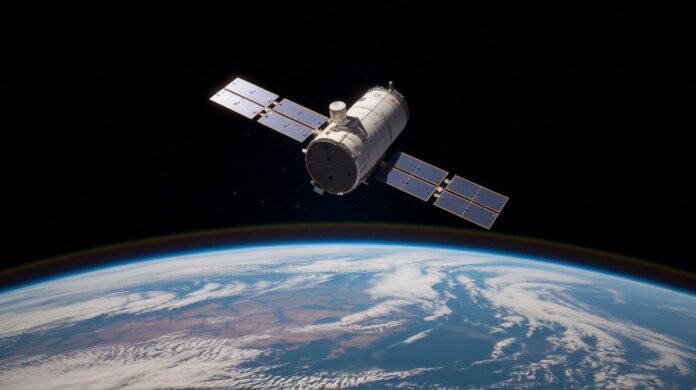
Ever wonder how satellites manage to float in space without crashing into Earth? It all comes down to orbital speed. Imagine tossing a ball so fast that it never lands. That’s sort of what a satellite does, it moves quickly enough so that while Earth pulls it in, its speed keeps it from falling.
In our post, we dive into the simple math that balances a satellite’s momentum (the force of its movement) with Earth’s pull. Whether a satellite is zipping near the planet or gracefully hovering in geostationary orbit (a spot where it stays above the same place on Earth), we break it down in easy steps. Curious about how these space marvels work? Let’s explore the stellar facts behind this amazing space technology.
satellite orbital speed: Stellar facts for enthusiasts
Orbital speed is the magic number a satellite needs to keep Earth’s pull perfectly balanced with its own momentum. In plain talk, it’s the pace that lets a satellite keep circling instead of plummeting to Earth. Imagine tossing a ball so hard that it never lands, but instead keeps orbiting the planet, that’s pretty much the idea behind orbital motion.
At low Earth orbit, which sits between about 200 and 2,000 km above us, satellites zoom at roughly 7.8 km/s (28,000 km/h). Fun fact: the International Space Station zips around at nearly 7.66 km/s (27,600 km/h), and thanks to this speed, it catches almost 16 sunrises and sunsets every single day! This brisk pace is what keeps it floating above our heads, fighting off Earth’s pull.
Now, if you look higher up, geostationary satellites are in action at around 35,786 km altitude. They move slower, approximately 3.07 km/s (11,000 km/h), but that’s by design. Their speed is carefully set so they match Earth’s 24-hour spin, letting them hover right over the same spot.
In both cases, scientists rely on trusty orbital formulas to balance gravity with the needed centripetal force (that’s the force keeping an object moving in a circle). When these forces mesh well, the satellite stays on track, making everything from weather forecasts to global communications work like clockwork.
Mathematical Derivation of Satellite Orbital Speed
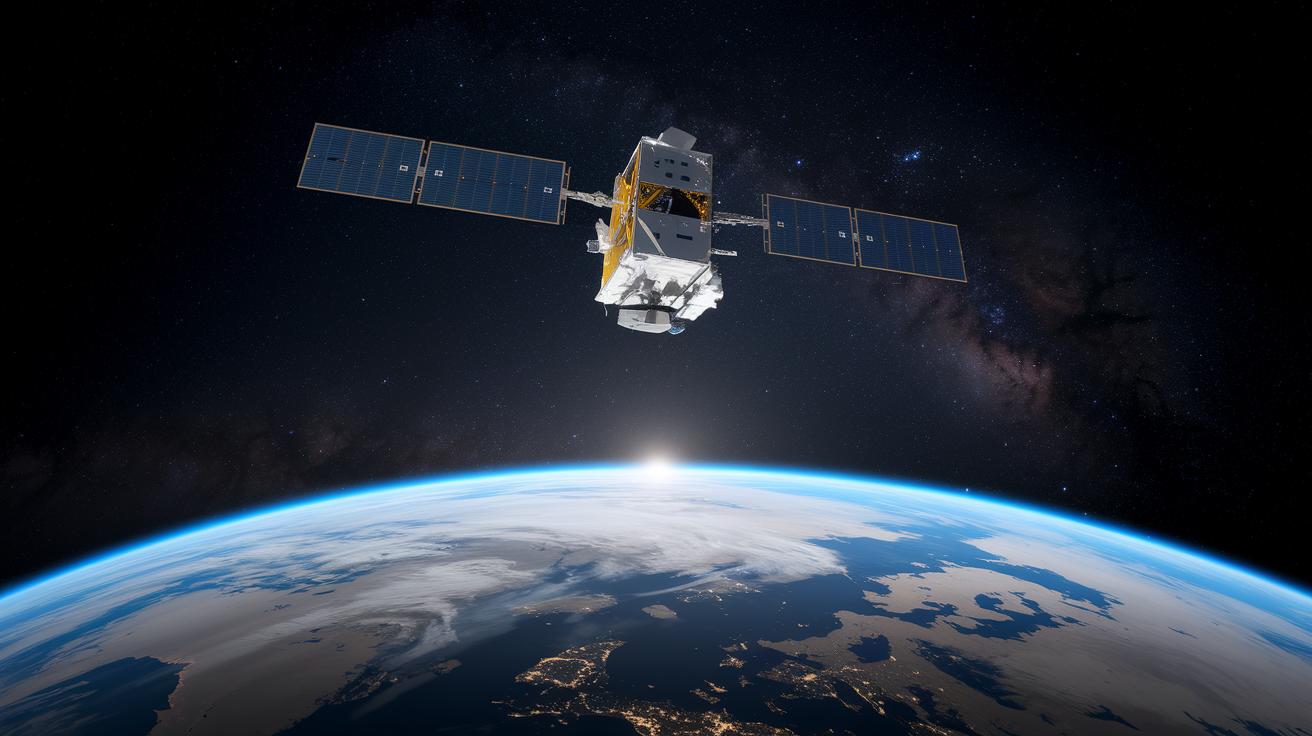
We start by matching the force that keeps a satellite in its circular orbit with Earth’s pull of gravity. The satellite feels a centripetal force, which is described as m·v²/r, here, m is the satellite’s mass, v is its speed, and r is its distance from Earth’s center. At the same time, Earth pulls the satellite inward with a gravitational force calculated as G·Mₑ·m/r². (G is the gravitational constant, a number that tells us just how strong gravity is, and Mₑ is the mass of Earth.)
When we set these two forces equal, we get the equation:
v²/r = G·Mₑ/r²
Next, we multiply both sides by r to cancel one r, leaving us with:
v² = G·Mₑ/r
Taking the square root of both sides gives the orbital speed:
v = √(G·Mₑ/r)
This neat formula shows that the satellite’s speed slows down as its distance from Earth increases because the speed depends on the inverse square root of the orbital radius.
Now, let’s talk about centripetal acceleration, defined as a₍c₎ = v²/r. This acceleration is what keeps the satellite moving in a smooth circle around Earth. In simple terms, the faster the satellite goes for a given distance, the stronger its inward acceleration must be to stay on track.
We can also determine how long it takes for one complete orbit, known as the orbital period T. The formula is:
T = 2πr/v
This tells us that if a satellite moves faster at a fixed distance, it completes its orbit in a shorter time, while a slower speed means a longer orbital period.
For a real-world example, imagine a satellite orbiting 500 km above Earth’s surface. Adding Earth’s average radius of about 6,371 km gives a total orbital radius of roughly 6,871 km. When you plug that into the orbital speed formula, you get an approximate speed of 7.61 km/s (or about 27,400 km/h).
In essence, this derivation not only shows how gravitational pull and centripetal force work together to keep a satellite in orbit, but it also highlights how changes in altitude can significantly affect its speed.
How Altitude Influences Satellite Orbital Speed
Satellite speed in orbit drops as the distance from Earth grows. In simple terms, the closer a satellite is to Earth, the faster it needs to move. For example, a satellite just 200 km above Earth (adding Earth’s approximate 6,371 km radius gives an orbital radius of about 6,571 km) zips around at roughly 7.8 km/s. But if you lift it to 36,000 km up, the full radius comes to 42,371 km and its speed slows to nearly 3.1 km/s.
At lower heights, satellites feel a lot of atmospheric drag, which is like trying to push a toy car on a thick carpet, it just slows down quickly. That’s why satellites closer to Earth need frequent little nudges to stay on track. On the other hand, those far out face less drag but might have to use extra thrusters to keep their orbit steady due to weak pulls from the moon and sun.
There’s also the challenge of tweaking a satellite’s path. Higher up, the slower speed makes moving around a bit trickier, much like riding a slowly turning carousel versus one that spins quickly, each requiring different handling techniques.
Comparing Orbital Speeds: LEO, MEO, and GEO
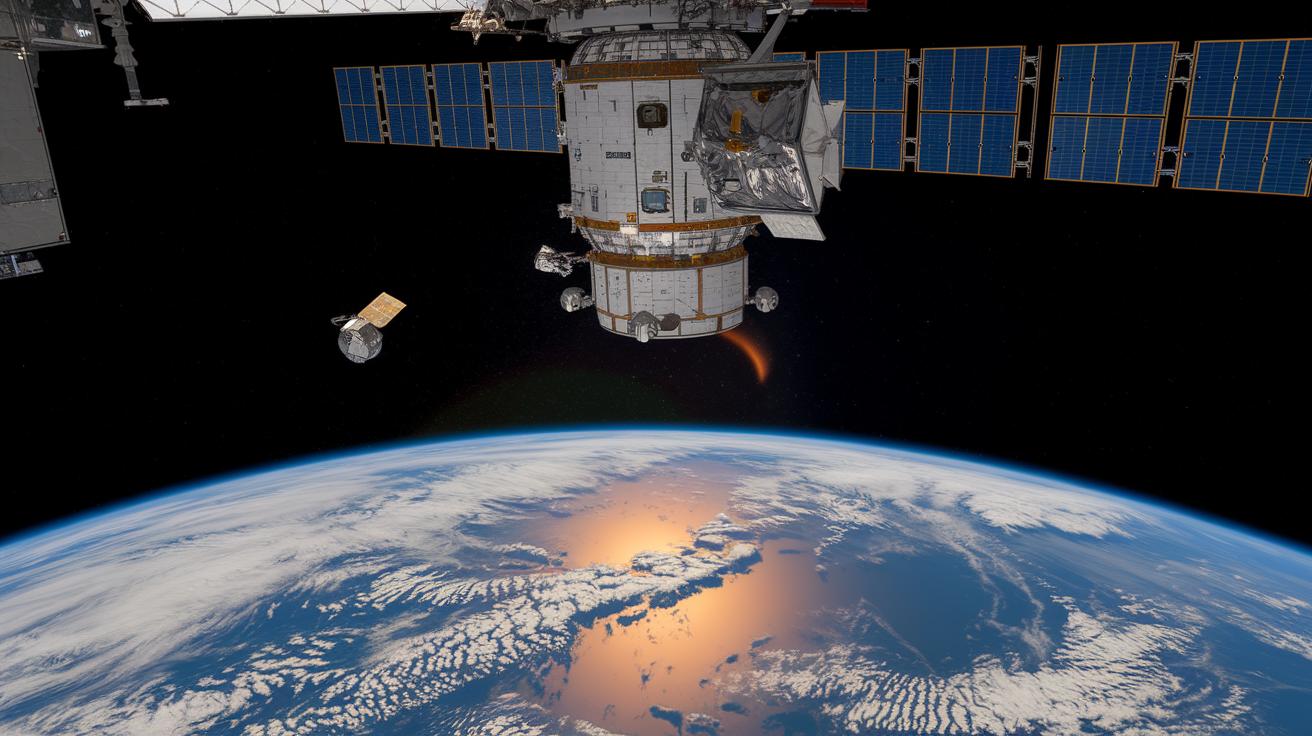
Satellites in different orbits zip around at very different speeds. In low Earth orbit, which sits between 200 and 2,000 km above us, satellites race at about 7.8 km per second, roughly 28,000 km per hour. This breakneck speed lets them circle the Earth in about 90 minutes, perfect for quick shots of Earth observation or rapid response communication.
Then there’s medium Earth orbit. Satellites here, like those used in the GPS system (hovering near 20,200 km), cruise at around 3.87 km per second, or about 13,900 km per hour. Because they move at a more relaxed speed, they take roughly 12 hours to complete an orbit, striking a balance between wide coverage and steady movement.
Way up high, geostationary satellites go around at about 35,786 km. Their pace drops further to nearly 3.07 km per second (about 11,000 km per hour). Their slower speed is no accident, it lets them match the Earth’s rotation by finishing one orbit in 24 hours so they seem to hang in one spot above our planet.
These numbers come from the math behind circular orbits, where the inward pull of gravity equals the force keeping the satellite on track. For a quick look, check out this table:
| Orbit Type | Altitude (km) | Speed (km/s & km/h) | Period (min/h) |
|---|---|---|---|
| LEO | 200–2,000 | ~7.8 km/s (28,000 km/h) | ~90 min |
| MEO | ~20,200 | ~3.87 km/s (13,900 km/h) | ~12 h |
| GEO | ~35,786 | ~3.07 km/s (11,000 km/h) | ~24 h |
Isn’t it amazing how these satellites manage their speeds to balance Earth’s gravitational pull? Every orbit is like a carefully choreographed dance, combining physics and precision to keep your GPS, weather forecasts, and live TV coming your way.
Real-World Satellite Orbital Speed Examples
The International Space Station soars high at about 408 km above Earth, zipping along at roughly 7.66 km per second (that’s 27,600 km per hour). In just 92 minutes, it makes a full loop around our planet. Think of it like a high-speed performer perfectly balancing gravity and momentum to stay in a smooth, circular orbit.
Up a bit higher, the Hubble Space Telescope orbits near 540 km. It cruises at around 7.57 km per second (about 27,300 km per hour). This slight drop in speed is just right for its mission, snapping clear images of distant stars and galaxies. Its steady pace gives scientists the perfect window to explore deep space.
Then there’s TESS, which follows a more elliptical route. When it reaches its closest point to Earth, TESS can hit speeds up to 10.8 km per second (almost 39,000 km per hour). This shows that satellite speeds can vary a lot depending on the mission. TESS uses its rapid yet flexible movement to scan enormous areas of the sky in search of exoplanets.
And wow, the Parker Solar Probe is on another level. At its closest approach to the Sun, it blasts by at an incredible 192 km per second (about 690,000 km per hour). This extreme speed lets it brave the Sun’s intense heat and radiation, giving us amazing insights into our star’s behavior.
In essence, these examples show how each satellite’s speed is finely tuned to its unique mission, proving that whether it’s for a detailed image or a daring dive near the Sun, the right speed is key to success.
Software and Analytical Tools for Orbital Speed Calculation

When it comes to calculating satellite orbital speed, combining cool software with hands-on methods really makes the task simple. NASA's GMAT and AGI's STK let you run realistic simulations, showing how a satellite's speed balances the pull of gravity and its own forward momentum. It’s like watching a virtual dance where everything has to be in perfect harmony.
Open-source Python libraries such as poliastro make it even more interactive. They let you dive into formulas like v = √(GM/r), here, GM means Earth’s gravitational constant times its mass, and r is the distance from Earth’s center. Imagine coding a loop to check speeds at different heights; you'll see that satellites in higher orbits actually move more slowly. It’s a hands-on way to truly grasp the magic behind orbital dynamics.
Spreadsheet calculators are another smart option. Simply input a satellite’s altitude and Earth’s gravitational constant, and watch the speed pop up instantly. This method bridges the gap between textbook physics and everyday number crunching, offering both beginners and pros a clear, practical view of how satellites work in orbit.
Using these tools makes exploring orbital mechanics both engaging and clear, you can experiment with data while truly understanding the science behind a satellite’s pace.
Elliptical vs. Circular Satellite Orbital Speed Variations
In a circular orbit, a satellite cruises at a steady speed defined by v_circ = √(GM/r). Think of it like a perfectly balanced dancer circling around Earth, where every move counters gravity’s pull. But if the satellite zooms a bit faster than this ideal speed, things get interesting, it starts carving out an elliptical path using the vis-viva equation: v = √[GM (2/r – 1/a)], where a is the semi-major axis, essentially the orbit’s average stretch.
When the orbit becomes elliptical, the satellite doesn’t stick to a constant pace. It speeds up when it’s nearest to our planet (at perigee) and slows down when it drifts further away (at apogee). This natural ebb and flow is why we lean on Kepler’s Third Law, T² = 4π²a³/GM, to see how the orbit’s size tweaks the travel time. And here’s a neat tidbit: the escape velocity, v_escape = √(2GM/r) (about 11.2 km/s at Earth’s surface), is roughly 1.414 times the circular speed. That means if a satellite hits around 1.414 times its circular speed, it’s flirting dangerously with escaping Earth’s pull.
So, pushing past that balanced speed transforms a neat circle into a stretched ellipse and can even put the satellite on the brink of breaking free, all thanks to the delicate dance between speed, orbit shape, and gravity’s relentless tug.
Final Words
In the action, we explored how satellites maintain a perfect balance between gravity and the needed satellite orbital speed. We broke down core physics steps, compared speeds in low, medium, and high orbits, and even checked real examples like the ISS and Hubble. The maths behind their motion ties directly to everyday tech insights. Simulation tools and software bring a practical twist to these concepts, making it easier to visualize and grasp digital innovation. Always exciting to see physics helping us shape a smarter, more connected future.
FAQ
What is the satellite orbital speed formula?
What is the satellite speed in km/h?
What is the escape velocity of Earth and for a satellite?
How fast do satellites go in mph?

