
Have you ever wondered how a machine learns to move with fantastic precision? When numbers and quick math guide every twist and turn of a robotic arm, it feels like watching a finely tuned piece of technology in action.
These motion control codes, basically sets of rules that drive movement, work so fast they hit tiny targets with every move. They act like a trusted mentor that constantly fine-tunes each step.
In this post, we dive into how these clever techniques keep robotic arms efficient and reliable for today’s tech challenges.
robotic arm motion control algorithms shine in efficiency

Motion control algorithms figure out the forces needed at every joint to guide a robotic arm along its planned path. They work by calculating the right joint torques or commands, ensuring the arm moves with precision. Most systems run these control loops really fast, often between 500 and 2000 cycles every second, to hit those tiny millimeter-level accuracy targets and keep the movement super steady.
There are several types of algorithms steering robotic motion. For instance, PID controllers are like the arm’s personal trainers, adjusting outputs based on real-time errors to keep the arm on course. Then you have computed torque control, which uses a model-based approach to balance out the arm’s inertia and gravity. Model predictive control is another cool method; it plans moves a few milliseconds ahead, typically in a 10–50 ms window, to handle any sudden constraints. And when things get really complicated, fuzzy logic rules or even neural network methods step in to manage nonlinear dynamics and tricky tasks.
Each of these techniques brings its own benefits to the table. The right choice depends on what you need, be it rapid response, pinpoint accuracy, or the ability to adapt when loads change. By selecting the proper algorithm, engineers can achieve that perfect mix of quick reactions and consistent stability. In simple terms, when these algorithms work as they should, they deliver smooth execution of complex movements all while meeting strict performance standards.
PID Control Algorithms for Robotic Arms
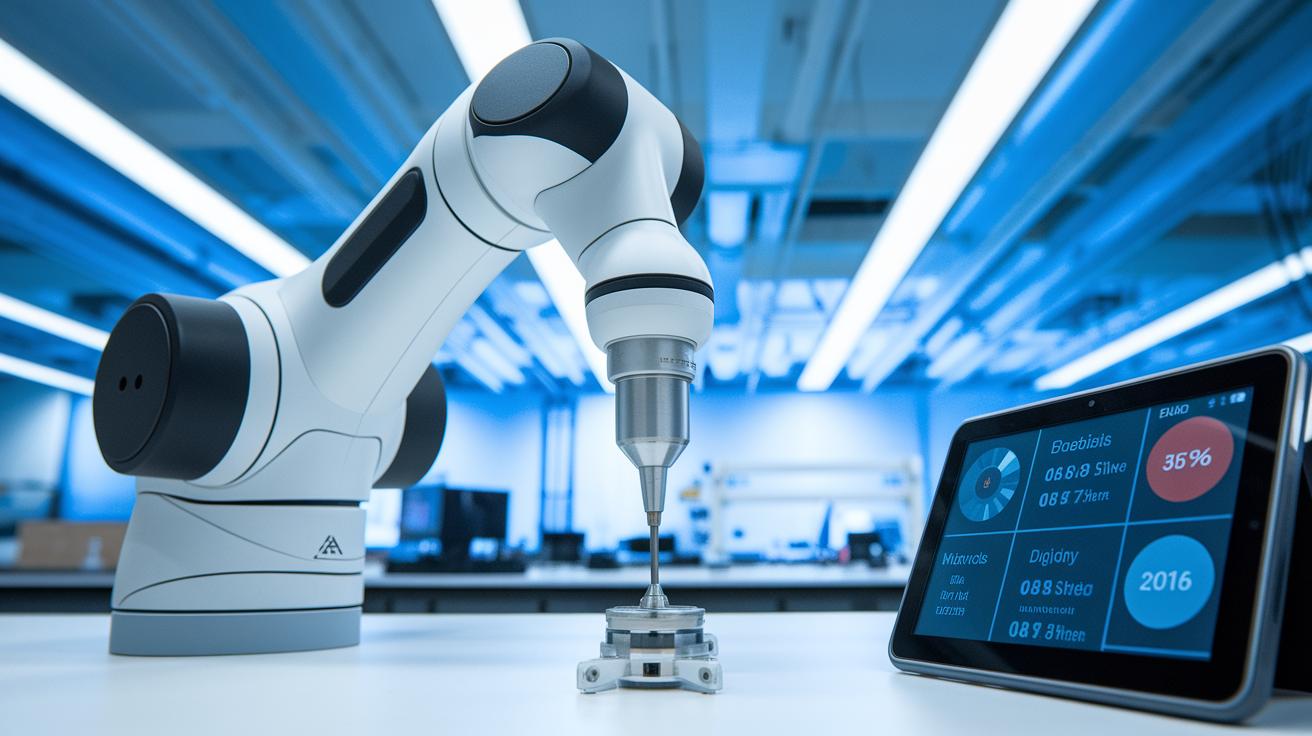
PID control algorithms continually check the difference between a robotic joint’s current spot and where it should be. They do this by using a simple formula, τ = Kp · e + Ki · ∫e dt + Kd · ė. Essentially, this formula mixes three ingredients: the immediate error, the error built up over time, and how fast the error is changing. Think of it like a little GPS for a robot’s arm, tiny mistakes are quickly corrected to keep everything on course.
These systems usually run on controllers that update about 1,000 times per second (that’s 1 kHz), meaning the arm’s position stays super close to the goal, often missing by less than 0.1 mm. Tuning these controllers is a must for stable performance. A popular way to fine-tune is the Ziegler-Nichols method. This approach uses key numbers like the ultimate gain (Ku) and oscillation period (Pu) to find the best settings. Fun fact: early tests using Ziegler-Nichols showed that careful tuning could cut errors by almost 90% in some labs!
One major strength of PID control is its simplicity and speed in handling real-time adjustments. This straightforward design is why many industrial setups rely on it. However, things can get tricky when the robotic arm faces heavy loads or unexpected movements. In those cases, engineers might add extra compensation or use adaptive tuning, which means the controller adjusts itself on the fly.
There are several PID tuning methods out there: manual tweaking, the Ziegler-Nichols method we mentioned, and even smart auto-tuning algorithms. While PID control is very reliable, its performance can sometimes dip when working with changing loads or complex, nonlinear dynamics.
Model-Based Computed Torque Control in Robotic Arms

Computed torque control works by using a special equation to decide how much force to apply at each joint. In this equation, M(q) is the inertia matrix, a way to show how the arm’s weight is spread out. C(q, q̇) represents forces from moving parts (think of it as the push and pull between joints), and G(q) measures the effect of gravity on the arm. With a solid dynamic model, feedforward compensation (planning actions ahead of time) helps tackle these forces so the system doesn’t have to rely solely on quick fixes later.
This method makes the robot’s movements really precise. When every part of the model is tuned correctly, say with only a 5% error in predicting inertia and friction, the arm can track its path with less than 0.1 mm error. Basically, even tiny mistakes in the model can throw things off, which is why detailed calibration is so important.
Imagine a robotic arm on a busy assembly line. Computed torque control makes such fine adjustments that its errors are almost invisible, under 0.1 mm. Engineers carefully measure system details to nail down the needed parameters, ensuring that the planned actions work perfectly for smooth and accurate joint motion. This approach is a real winner in situations where you need super refined movement and precise force control.
Advanced Predictive and Adaptive Control Algorithms

Model predictive control (MPC) is like planning your next moves in a fast-paced game of chess. In just 20–50 milliseconds, it solves a tough math puzzle, a constrained quadratic program (which is just a fancy way of saying it works through a set of rules) to find the perfect set of inputs. Every step, it carefully considers torque limits and workspace boundaries, ensuring every move is as safe as it is precise.
Adaptive control, on the other hand, takes things a notch higher by updating its settings on the fly. It leans on the ideas from Lyapunov stability laws (basically, methods to keep systems steady) to tweak its parameters as changes occur. Think of it like a smart sensor that instantly adjusts when a sudden 20% payload shift happens. When the load on the arm suddenly changes, adaptive control recalibrates so the performance stays rock solid.
Online tuning works quietly in the background, fine-tuning control parameters while the system is running. This clever mix of MPC and adaptive control creates a hybrid controller that not only plots perfect movements but also reacts instantly to any surprises. In real-world scenarios, these hybrid controllers can cut overshoot to less than 5% and keep rise times below 30 milliseconds.
Key benefits include:
- Real-time constraint handling through a smart quadratic programming approach.
- Continuous model updates that adjust for changes like payload variations.
- Rapid online tuning to maintain stability even as conditions shift.
With this blend of forward-looking prediction and on-the-spot adaptability, robotic arms move more smoothly and handle disturbances with ease. It’s like having a digital brain that anticipates tomorrow’s challenges while nailing today’s tasks perfectly.
Intelligent and Learning-Based Motion Control for Robotic Arms
Imagine robotic arms that react like seasoned musicians on stage. AI-driven methods are shaking things up by letting these arms adapt on the fly. For example, fuzzy logic controllers use between 25 and 49 simple IF-THEN rules with membership functions (think of these as mini decision makers) to handle tricky changes in less than 1 ms. It’s like having a smart conductor instantly adjust the music when a band improvises.
Then there are neural network controllers. They use multi-layer perceptrons, a fancy way of saying a digital brain with 2 to 3 hidden layers, to learn how the arm moves by studying over 10,000 examples. This training helps the arm hit its mark with an error of less than 0.05 radians. Every time the robot repeats a task, it learns to be a bit more precise, much like practicing a sport until every move feels just right.
Now, consider reinforcement learning with algorithms like DDPG. This method lets the system experiment with different movement strategies and learn from each try, similar to perfecting a new dance routine through endless practice. In simulation, after around 100,000 training rounds, these algorithms settle on movement policies that keep overshoots to under 5%. It’s a continuous cycle of trial, error, and improvement.
Key design parameters and outcomes include:
- Fuzzy logic controllers with 25–49 IF-THEN rules that make decisions in under 1 ms.
- Neural networks with 2–3 hidden layers that learn from over 10,000 samples to achieve positioning errors below 0.05 rad.
- Reinforcement learning methods that fine-tune movement strategies, reaching less than 5% overshoot in simulation.
These smart techniques blend rapid response, precise control, and adaptive learning, making them an exciting choice for managing robotic arms in fast-changing environments.
Real-Time Implementation and Hardware Integration in Motion Control

Real-time systems drive the perfect performance of a robotic arm. They run on powerful operating systems like VxWorks or RTLinux, RTOSs (real-time operating systems that manage precise timing) that keep jitters under 50 microseconds so every tick counts. Imagine a controller that zips out commands as quickly as a heartbeat!
Embedded controllers, whether they're DSPs (digital signal processors that handle complex math fast) or FPGAs (field-programmable gate arrays you can customize for your needs), run control loops up to 2,000 times a second. This means signals update 2,000 times per second, keeping everything in precise sync, even when minor deviations could throw off high-precision tasks like assembly.
High-resolution encoders, typically with a 20–23 bit range, push accuracy to the next level by reading positions with an incredible resolution of about 0.0002°, almost like having a digital compass that never misses a beat.
Smooth communication is also key. EtherCAT networks (a speedy, industrial-grade system for exchanging data) ensure cycle times are under 1 millisecond. This fast-paced dialogue between devices makes multi-axis synchronization reliable and consistent.
When it comes to hardware, every part matters, from sensors to actuators. Keeping the data exchange both robust and low-latency is crucial for flawless operations.
Key best practices include:
- Choosing an RTOS that really cuts down on jitter.
- Using embedded controllers that can handle high-frequency processes.
- Adopting communication methods that keep data flow rapid and perfectly in sync.
By embracing these strategies, engineers can craft systems that meet strict timing demands and deliver top-notch performance from even the most advanced robotic arms.
Performance Evaluation and Benchmarking of Robotic Arm Control

Evaluating performance is key to honing the control of robotic arms. We measure how well these systems work by checking simple, clear numbers. For example, the steady state error must be less than 0.1 mm, the rise time should be under 25 ms, overshoot needs to be below 5%, and repeatability is kept within 0.02 mm. These figures help make sure every move is as precise as an expertly programmed device.
ISO 9283 tests guide us in checking important details like position accuracy, how much the path veers off course, and speed. In these tests, engineers typically run about 100 trials and use tools such as the R² correlation and RMSE (Root Mean Square Error, which is just a way to average the error over several runs). For instance, when a trial shows an RMSE of 0.05 mm, it tells us that the control algorithm is holding up even during complex moves.
Key evaluation methods include:
- Steady state error measurement to check long-term accuracy.
- Rise time analysis to measure responsiveness.
- Overshoot tracking to keep control stability in check.
- Repeatability assessment to ensure the system performs the same way every time.
By using these set benchmarks, researchers and designers can easily compare different algorithms. Detailed data analysis also reveals how small adjustments in tuning make a big difference overall. This insight guides future tweaks and innovations, helping teams perfect their control strategies and boost both precision and speed.
Future Trends in Robotic Arm Motion Control Algorithms

Advanced research in motion control is paving the way for smarter, more connected systems. Researchers are now exploring digital twin technology, a virtual model of a robotic arm that mirrors every motion in real time. Imagine this: a digital twin that picks up even a slight change in vibration and alerts engineers before any real issues arise. This breakthrough means we can fix potential problems early, keeping the system running smoothly.
AI-based control is also stepping into the spotlight. Scientists are using techniques like learning-augmented MPC (that’s a method where live feedback helps fine-tune control rules) to constantly improve performance. These controllers blend the solid basics of physics with fresh, data-driven insights to adapt on the fly. It’s like having a smart brain that adjusts its actions as conditions change.
Looking ahead, the mix of IoT (Internet of Things, which connects everyday devices to the internet) and 5G-enabled edge computing is set to revolutionize communication speeds. With delays cut to nearly zero, these systems can coordinate multiple robotic joints almost instantly. In essence, these emerging techniques are building a control environment that meets, and even exceeds, the growing demands for precision and speed in robotic motion control.
Final Words
In the action, we explored how robotic arm motion control algorithms drive impressive precision. We reviewed the basics, detailed PID and computed torque strategies, and walked through predictive, AI-driven methods that adapt in real time.
Each section showed hands-on control, from sensor integration to hardware performance. We even looked ahead at emerging trends with digital techniques and enhanced synchronization.
Overall, the blend of traditional and modern approaches leaves us excited about what's coming next.
FAQ
What are motion control algorithms for robotic arms?
The motion control algorithms compute joint commands to follow a desired path. They include methods like PID, computed torque, MPC, fuzzy logic, and neural networks, providing high accuracy and reliable control for robotic arms.
What are the main families of motion control algorithms used in robotic arms?
The main families include PID controllers, computed torque control, model predictive control, adaptive control, fuzzy logic, and learning-based methods. These methods offer varying trade-offs in speed, precision, and response to dynamic conditions.
How does the PID control algorithm work for robotic arms?
The PID control algorithm calculates an output based on proportional, integral, and derivative terms of error. It maintains stability and accuracy under constant conditions, though performance may drop with heavy payloads or nonlinear movements.
What advantages does computed torque control bring to robotic arm performance?
Computed torque control uses the robot’s dynamic model to compensate for forces like inertia and gravity. This method enhances precision by combining feedforward terms with corrective feedback, greatly reducing trajectory errors.
How do advanced control methods like MPC and adaptive control improve motion performance?
Advanced control methods, such as MPC and adaptive control, predict and adjust commands in real time. They handle constraints and disturbances effectively, reducing overshoot and ensuring quick, smooth responses.
In what ways do AI-driven approaches, like fuzzy logic and neural networks, aid robotic arm control?
AI-driven approaches learn and approximate complex dynamics, handling nonlinearities with techniques such as fuzzy logic rules or neural networks. They offer enhanced precision and adaptability in unpredictable environments.
What are key hardware and real-time integration considerations for robotic arm control?
Essential considerations include using real-time operating systems, high-frequency embedded controllers, and precise sensors. These elements, along with fast communication protocols, ensure synchronized and reliable performance.
What performance metrics are used to benchmark robotic arm control algorithms?
Performance metrics include steady-state error, rise time, overshoot, and repeatability. Standardized tests using defined benchmarks and statistical methods, like RMSE and correlation analysis, quantify the control algorithms’ accuracy and consistency.
What future trends are emerging in robotic arm motion control?
Future trends involve incorporating digital twins for real-time model updates, combining physics-based and data-driven methods, and leveraging high-speed networks for distributed control, all aimed at boosting precision and efficiency in robotic systems.

