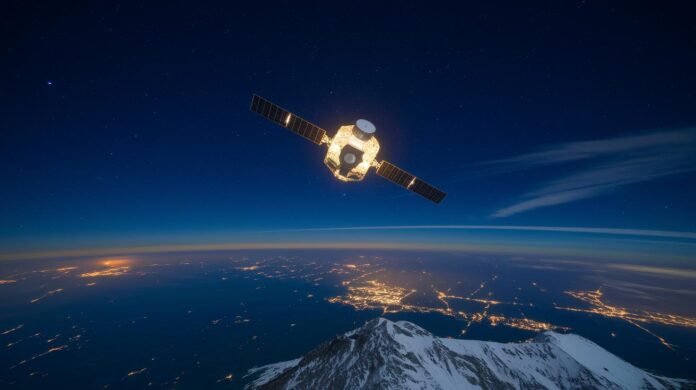
Ever wondered which orbiting wonder really steals the spotlight in our cosmic show? Take a moment to picture Ganymede. It’s nature’s biggest moon with frosty, expansive plains that shine like a well-lit digital display. And then there’s the International Space Station, a brilliant creation of human design gently floating above us.
In this piece, we’re diving into what makes these celestial marvels so fascinating. We’ll explore how Ganymede’s natural power meets human ingenuity and why their enormous scale fills us with endless curiosity. Isn’t it amazing how nature and tech come together to light up our universe?
Overview of the Largest Satellite: Natural and Artificial Giants
Satellites are objects that circle around a planet – they could be natural, like our moon, or built by humans for tasks like communication, observation, or scientific research. Think of them as space companions that help us explore the universe. In our solar system, Jupiter’s moon Ganymede holds the title of the largest natural satellite with a diameter of 5,268 km. Its enormous size is a reminder of the wonders nature creates all on its own.
On the human-made front, the International Space Station is the largest artificial satellite ever built. With dimensions of 356 ft by 240 ft and a weight of about 450 tons, the ISS is like a floating workshop in orbit. Built from several pressurized modules, it showcases what human ingenuity and creativity can achieve in space exploration.
Exploring the Largest Natural Satellite in the Solar System
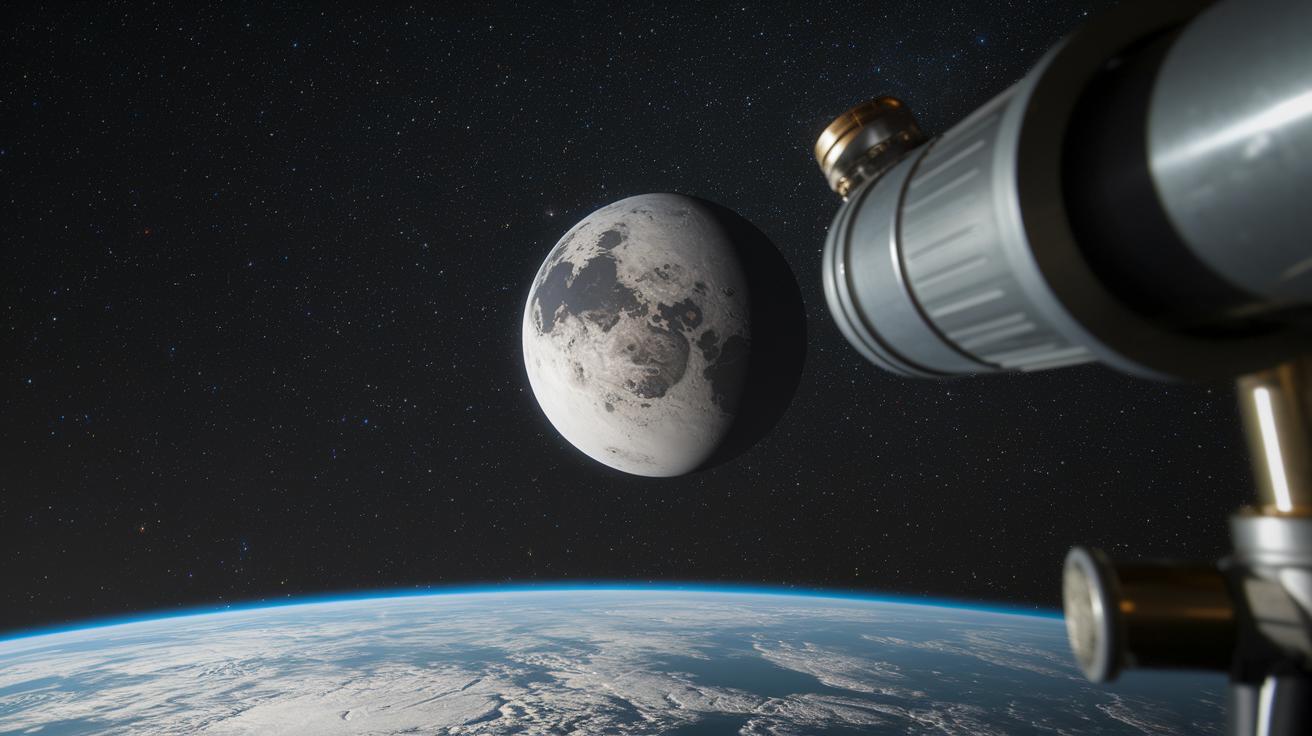
Ganymede is the biggest moon in our solar system, measuring 5,268 km across and weighing about 1.48 × 10²³ kg. Galileo first discovered this striking moon on January 7, 1610, using his early telescope. Just imagine looking through a telescope and seeing a huge orb that even rivals Mercury in size. Amazing.
This moon isn’t just big, it’s also unique. Its smooth, icy patches mingle with darker spots, much like a painter mixing different colors to add depth. These features hint at a lively past with shifting tectonics and maybe even a secret ocean hidden beneath its frozen skin. Ever wonder what mysteries lie deep within its surface?
As Jupiter’s largest companion, Ganymede towers over its fellow moons. Its sheer scale and varied landscape make it a constant source of wonder for scientists. With every discovery, we get a little closer to understanding the dynamic mix of elements that make up our solar system.
The Largest Satellite Humans Have Built: International Space Station
The ISS isn’t just an orbiting structure, it’s a symbol of global teamwork. Built by space agencies in the United States, Russia, Europe, Japan, and Canada, its creation brought together engineers and scientists from all walks of life. They coordinated across different time zones and cultures, making this collaboration as groundbreaking as it sounds.
This floating laboratory keeps pace with the latest tech. Engineers often venture out on spacewalks and run robotic repairs to keep systems running smoothly and to add fresh, innovative elements. Think of it like updating your smartphone’s software while you're actually using it. These timely upgrades allow the ISS to continually support advanced research in microgravity and test new technology meant for deeper space adventures.
Scientists onboard push the limits of what we know about biology and materials science. Microgravity experiments there have even helped create alloys that are both lighter and stronger, just like a cool upgrade for aerial vehicles. It’s a constant showcase of how space can spark new ideas.
Plans are already in motion to extend missions and boost research potential. Future updates will streamline maintenance and add even more cutting-edge technology, ensuring that the ISS remains a vibrant hub for science and international cooperation.
Other Record-Holding Artificial Satellites: From BlueWalker-3 to Envisat
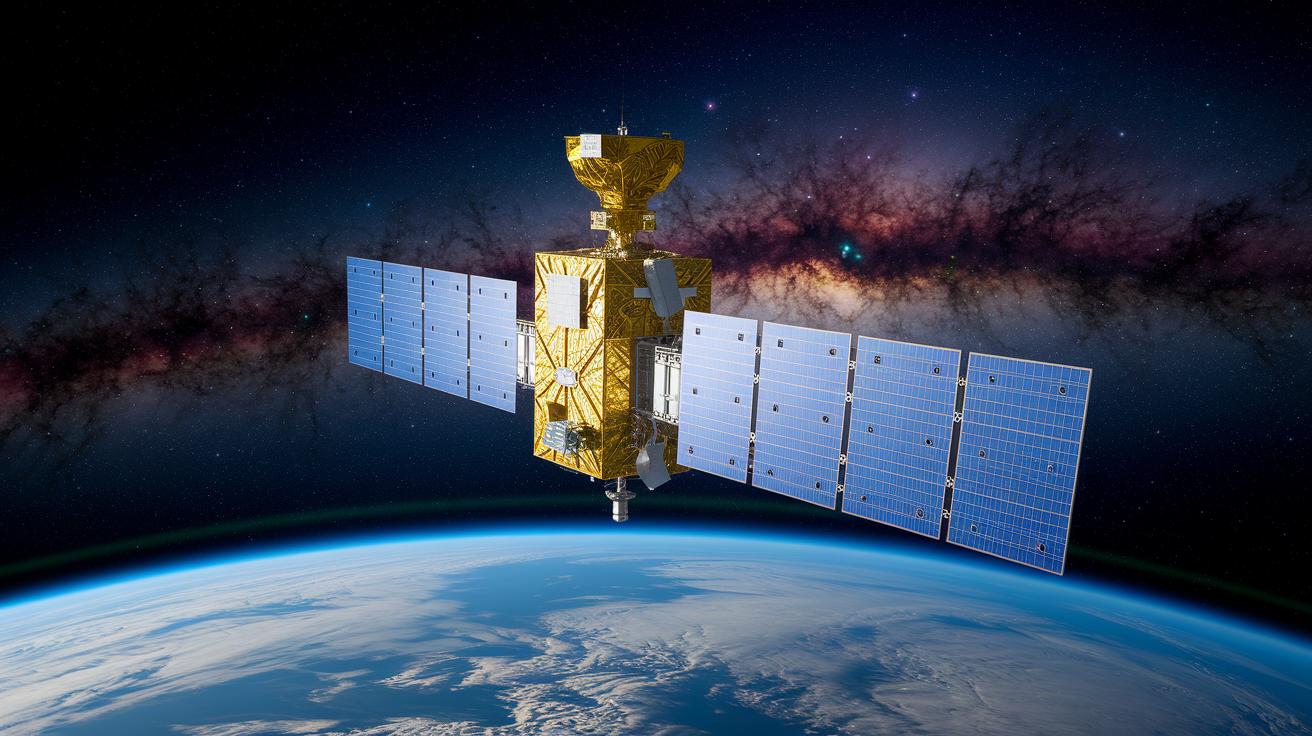
BlueWalker-3 is a real standout in the world of satellite engineering. It’s known as the biggest commercial communications array around, dazzling with its size and brightness. This satellite blends innovative tech with solid performance, setting the bar high for future designs.
Then there's Mir, a pioneering modular space structure that measured 108 ft by 101 ft and weighed 309,000 lb. It proved that even a compact satellite can handle a variety of research tasks. The Hubble Space Telescope, though only 43.5 ft in length and about 27,000 lb in weight, has provided over 1.3 million precise observations that reshaped how we see the cosmos.
Skylab, at roughly 170,000 lb, served as an important hub for long-term scientific studies. Meanwhile, Envisat, almost 33 ft long and weighing 18,100 lb, gathered vital data about our Earth. And let’s not forget the Automated Transfer Vehicle, this 20-ton resupply expert played a key part in keeping the International Space Station running smoothly.
Each of these satellites marks an important step in our journey through space technology, merging creativity with groundbreaking innovation.
| Satellite | Dimensions / Length | Weight |
|---|---|---|
| Mir | 108 ft × 101 ft | 309,000 lb |
| Hubble Space Telescope | 43.5 ft | 27,000 lb |
| Skylab | N/A | 170,000 lb |
| Envisat | 33 ft | 18,100 lb |
| ATV Resupply Vehicle | N/A | 20 tons |
Ranking Satellellites: Size Comparisons and Their Implications
Have you ever thought about how a satellite’s size can shape its development and guide tech decisions? Natural moons like Ganymede and Titan keep scientists talking. Ganymede, for instance, thrills researchers not just because it’s massive but also because its surface hints at busy processes inside. Titan, with its dense, hazy air, pushes us to rethink how moons evolve. It’s almost like Ganymede, a true heavyweight, hides a surprisingly intricate interior, while Titan’s thick atmosphere keeps us asking, "What chemical mysteries lie within?"
Then there are our man-made orbital structures. The ISS, Skylab, and Mir changed the game with their designs. They challenged engineers to create habitats where humans could live in space for long stretches. Take the ISS: its clever, modular design is a blueprint for future in-orbit construction projects. Skylab and Mir, early trailblazers in space habitation, steered designers to focus on crew safety and easy repair methods while floating hundreds of miles above Earth.
Key points to remember:
- Natural moons give us clues about how our solar system came together through their size and air.
- Artificial satellites show how design and tech adapt to meet human goals in space.
| Orbital Object | Scientific/Tech Insight |
|---|---|
| Ganymede | Its surface activity hints at a layered, dynamic interior |
| Titan | The thick atmosphere sparks debates on moon evolution |
| ISS | The modular design paves the way for future in-space construction |
| Skylab/Mir | These early space habitats shaped crew safety and maintenance practices |
Future of the Largest Satellite: Emerging Mega-Orbital Projects

Space network companies and creative firms are getting ready to push the boundaries of satellites with projects that are huge in both scale and design. Take SpaceX Starlink, for example. They plan to launch a fleet of 1,500 satellites and have already set a record by sending 143 satellites into space in one go. This big move makes us wonder how new space tracking tools will handle all the action as more satellites crowd the orbit.
Next, satellite rideshare missions are looking to become a regular thing, which means cheaper rides into space. New communication arrays are on the horizon too, promising better connections and faster data speeds. At the same time, there are concerns about interference with Earth-based radio telescopes, which could mess with important astronomical observations.
All these upcoming projects, mixed with advanced tracking systems, are setting the stage for a lively new era in space networks. It’s an exciting blend of cutting-edge technology and careful monitoring, making sure we explore space boldly while keeping everything under control.
Final Words
In the action, we explored space giants by comparing natural wonders like Jupiter’s moon Ganymede to man-made marvels such as the ISS. We examined key size metrics, detailed engineering feats, and even peeked at upcoming mega projects that promise to push boundaries further.
We discussed how records are set and broken by both realms, giving you a clear look at the expansive, dynamic universe of satellites. Dive into the world of the largest satellite and let your passion for tech continue to grow.
FAQ
What is the largest satellite in the world?
The largest satellite in the world is Jupiter’s moon Ganymede, which measures about 5,268 km in diameter and stands out as the biggest natural orb orbiting a planet.
What is the largest satellite ever made?
The largest human-built satellite is the International Space Station, a sprawling engineering feat with dimensions around 356 ft by 240 ft and a mass of roughly 450 tons.
Is the ISS the biggest satellite?
The ISS is the largest artificial satellite, and though it dominates human-made objects in orbit, natural satellites like Ganymede are much larger in scale.
What are the largest satellite dishes on Earth and in the US?
The largest satellite dishes, both globally and in the US, are massive communication instruments designed for precise signal reception and transmission, and they often feature impressive sizes and robust structures.
What does the term ‘world’s largest satellite dish collapse’ refer to?
It refers to severe structural failures experienced by large communication arrays, highlighting the need for careful maintenance to keep these crucial devices operational.
How do natural satellites compare to human-made ones?
Natural satellites like Ganymede far exceed the size of human-made satellites such as the ISS, showing a stark contrast in their origins, designs, and purposes.
How are satellites like Tiangong, Mir, and Skylab significant?
Satellites such as Tiangong, Mir, and Skylab played key roles as modular space labs and orbital platforms, each contributing uniquely to our knowledge of space and advancing research capabilities.
Is Starlink considered a single large satellite?
Starlink is not a single satellite but rather a constellation of many small satellites that work collectively to provide global communication coverage, rather than constituting one large unit.
What records do satellites orbiting Saturn or Uranus hold?
The record-holding satellites of Saturn and Uranus are natural moons recognized for their size and unique features, offering scientists valuable insights into planetary systems far beyond Earth.
What are some notable examples of record-breaking artificial satellites?
Beyond the ISS, projects like the Galileo project, Space Shuttle, and earlier stations like Skylab have set benchmarks in satellite engineering, each marking a milestone in our ongoing exploration of space.

