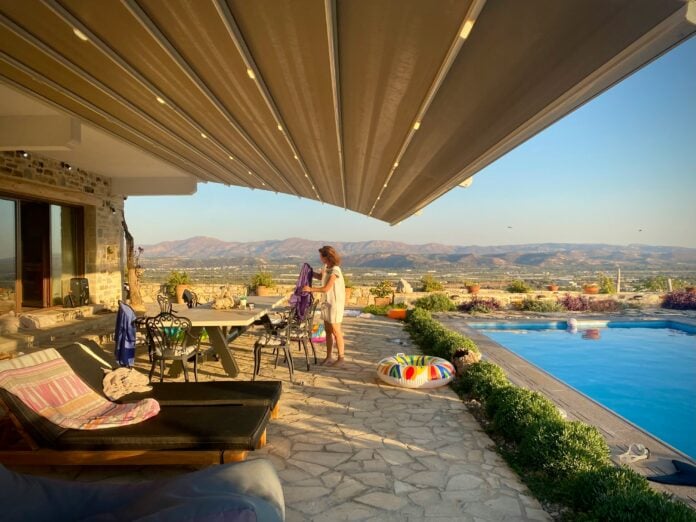
Sitting on a back patio during the peak of summer is a fantastic idea until the afternoon sun starts beating down, turning your relaxing oasis into a miserable sauna. We have all experienced that desperate scramble to drag a faded umbrella across the deck just to find a tiny patch of shade. Fortunately, outdoor living has evolved drastically. Upgrading your outdoor space with retractable awnings eliminates this problem, allowing you to control the weather on your patio with the simple push of a button.
While they might look like simple pieces of canvas stretching out over a deck, today’s retractable awning is actually a highly engineered piece of machinery. It relies on complex tension systems, specialized tubular motors, and automated weather sensors to function flawlessly year after year. Let’s take a look under the canvas and explore the technology that makes these dynamic shade structures work so effortlessly.
Torsion Bars and Roller Tubes
The entire weight of the system is supported by a heavy-duty torsion bar. This is a thick, structural metal beam that mounts directly to the siding, fascia, or roofline of your home. It acts as the spine of the awning, keeping the entire structure perfectly aligned and distributing the physical load across the mounting brackets.
Just above or in front of this torsion bar sits the roller tube. This is the cylindrical spool that physically holds the fabric. When the retractable awning is closed, the fabric is tightly wrapped around this tube. The quality of this metal is absolutely critical. If the tube is too thin, a wide awning will eventually sag right in the middle, causing the fabric to wrinkle and creating pools of standing water during a storm. Premium manufacturers use heavily reinforced, rust-proof aluminum roller tubes to ensure a perfectly tight, smooth fabric roll every single time.
Lateral Arm Technology
The most fascinating mechanical element of these shade systems is how they manage to push outward and stay perfectly rigid without requiring any ugly vertical support poles blocking your view. This is achieved through spring-loaded lateral arms.
Inside these folding metal arms is a highly calibrated tension system. Typically, this involves heavy-duty internal steel springs connected to a series of stainless steel cables or thick metal chains running directly through the elbow joints of the arm. When the retractable awning is closed, these internal springs are pulled incredibly tight, storing a massive amount of kinetic energy.
As the roller tube begins to unspool the fabric, the tension inside those springs is finally released, forcefully pushing the lateral arms outward. It is a brilliant balancing act. The arms are constantly trying to push away from the house, while the fabric attached to the roller tube pulls back, creating the perfect amount of horizontal tension to keep the canvas drum-tight and structurally sound.
Tubular Motors
While manual hand cranks are still available for smaller setups, the vast majority of modern shade systems rely on electric motors. You will not see a bulky engine bolted to the side of the housing. Instead, they utilize specialized tubular motors.
A tubular motor is a highly compact, cylindrical engine designed to slide directly inside the hollow center of the roller tube. It is completely hidden from sight and protected from the harsh outdoor elements. When you press a button on your remote control, the motor engages and spins the tube. It has built-in limit switches that tell the motor exactly when to stop spinning, ensuring the fabric never unrolls too far and never rolls up so tight that it damages the housing. Despite their small footprint, these motors generate an immense amount of torque, easily moving structures that span twenty feet wide and project over ten feet out from the wall.
Environmental Sensors
The biggest threat to a large piece of stretched fabric is a sudden, violent windstorm. A strong updraft can catch an open retractable awning like a giant sail, potentially ripping the mounting brackets right out of your siding. To prevent this catastrophic damage, modern technology relies heavily on automated environmental sensors.
Wind sensors, often called motion sensors or anemometers, are usually mounted directly to the front profile bar. If the wind picks up and the front bar starts bouncing violently, the sensor detects the erratic movement and immediately sends a wireless radio signal to the tubular motor. The motor overrides your manual settings and automatically retracts the structure into its protective housing before any structural damage can occur.
Similarly, sun sensors completely automate the cooling process of your home. You can program these small devices to measure the intensity of the sun hitting your deck. When the afternoon sun reaches a certain heat threshold, the sensor automatically deploys the retractable awning. This blocks the harsh rays from hitting your sliding glass doors, drastically lowering the indoor temperature of your living room and reducing your monthly air conditioning bill without you lifting a finger.
High-Performance Textiles
Mechanical arms and smart motors are useless if the fabric itself falls apart after one summer. The textile technology used in these systems is just as advanced as the hardware. Traditional cotton canvas rots, holds moisture, and fades immediately. Today, premium systems use tightly woven, solution-dyed acrylic fabrics. During manufacturing, the color pigments are mixed directly into the liquid acrylic before the fibers are even spun. This means the color goes all the way through the thread. It completely prevents ultraviolet fading and ensures the material naturally repels water and resists mold growth.
Adding dynamic shade to your backyard is not just about stretching a piece of cloth over your head. It is about installing a highly refined piece of automated machinery. By combining heavy-duty internal spring tension, hidden tubular motors, and highly intelligent weather sensors, these systems take the intense, unpredictable elements of summer and put them entirely under your control.

