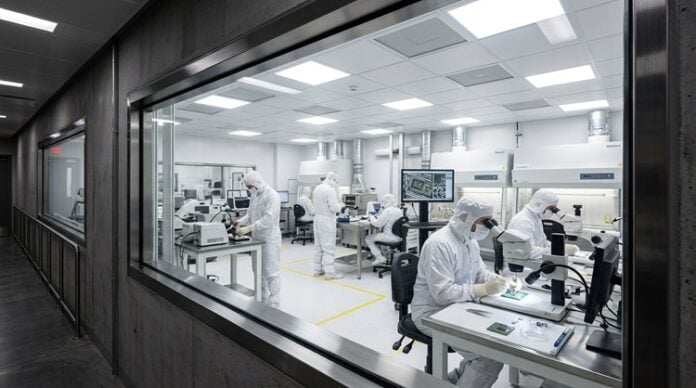
Why Controlled Environments Matter in Medical Device Production
A clean room for medical devices is a production space where airborne contamination is controlled to levels low enough to prevent particulate matter, microbial contamination, and other environmental factors from compromising device safety, sterility, or performance. The justification for this investment is straightforward: a medical device that reaches a patient carrying contamination introduced during production carries a risk that no subsequent sterilisation protocol may fully address. The cleaner the production environment, the lower the bioburden on the device before sterilisation, and the greater the sterility assurance level achievable through the sterilisation process.
The Science Behind Cleanroom Classification
Clean room for medical devices is classified according to ISO 14644-1, which defines maximum permissible airborne particle concentrations at specified particle sizes. ISO Class 7 limits particles to 352,000 per cubic metre at 0.5 microns and 2,930 at 5 microns. ISO Class 5 reduces these to 3,520 at 0.5 microns, providing the high level of control required for filling operations and the assembly of implantable devices where zero contamination tolerance applies. ISO Class 8 sets a less stringent limit of 3,520,000 particles at 0.5 microns, applicable to lower-risk operations and sub-assembly stages.
These classifications are not theoretical targets; they are verified through particle count monitoring at defined locations on a defined schedule, with the results reviewed against alert and action limits.
The Components of an Effective Cleanroom System
Medical device clean room production requires a combination of physical infrastructure and operational protocols working together. HEPA filtration removes particles down to 0.3 microns with 99.97 percent efficiency; ULPA filtration extends this to 0.12 microns for higher-classification spaces. Positive air pressure relative to adjacent lower-classification areas prevents contaminated air from migrating into the controlled space when doors open. Smooth, non-particle-shedding surfaces on walls, floors, and ceilings are cleanable and do not generate the particulate that porous or textured surfaces would release.
Environmental monitoring covers particle counts, temperature, relative humidity, and differential pressure, with all readings recorded and reviewed to verify that conditions remain within the qualified operating range.
Personnel as the Primary Contamination Source
“In manufacturing, discipline is not a constraint; it is the precondition for safety,” a principle that experienced medical device manufacturers apply to every aspect of cleanroom operation. Controlled environment device manufacturing recognises personnel as the single largest source of particulate and microbial contamination in controlled production spaces. A person moving normally generates approximately 100,000 particles per minute at 0.5 microns or larger. Gowning in a full cleanroom suit, gloves, head cover, and face mask reduces that generation rate significantly, and gowning discipline is verified through training programmes and periodic compliance assessments.
Material transfer into the cleanroom follows defined protocols: outer packaging is removed outside the controlled area, components are wiped down and transferred through airlocks, and nothing enters the cleanroom space without a defined transfer procedure.
Regulatory Requirements for Cleanroom Production
Clean room for medical devices is a regulatory requirement for medical device manufacturers producing sterile devices or implantable products. The FDA requires, under 21 CFR Part 820, that medical device production be conducted in conditions that prevent contamination. The EU MDR requires manufacturers to implement and maintain appropriate conditions throughout the manufacturing process. ISO 13485 requires that special conditions be defined and controlled for operations where the environment could adversely affect product quality.
Cleanroom qualification, through Installation Qualification, Operational Qualification, and Performance Qualification, generates the documented evidence that the environment meets the specified conditions before production begins.
The Operations Conducted in Medical Device Cleanrooms
Sterile and controlled medical device production covers a range of operations depending on the device type and complexity. Sub-assembly of structural components is often conducted in ISO Class 8 or white room conditions. Final assembly of sterile devices and implantables is conducted in ISO Class 7 or Class 5 conditions. Filling of sterile liquid drug-device combinations requires ISO Class 5 or aseptic conditions. Primary packaging of sterile devices must be completed within the controlled environment before the package seal is closed.
Each operation type has its own qualification requirements, documented work instructions, and inspection steps that generate device history records.
Maintaining Cleanroom Performance Over Time
A cleanroom that meets its classification at qualification does not automatically maintain those conditions over months of production. Clean room for medical devices requires periodic requalification of the environment, regular filter integrity testing, and continuous environmental monitoring to confirm that conditions remain within validated limits. Personnel refresher training, gowning compliance assessments, and equipment maintenance programmes contribute to sustained performance.
A clean room for medical devices that is properly designed, qualified, and maintained provides the production foundation that patient safety and regulatory compliance depend on.

