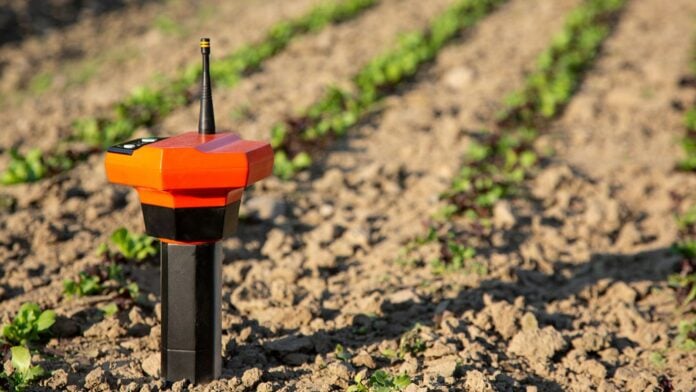
Farmers make expensive decisions about water and fertilizer based on what they can see above ground. Teralytic set out to show them what was happening below it, with a wireless sensor pushed into the soil.
The company worked with Tomorrow Lab®, a product design and engineering studio in Brooklyn, New York, from 2016. The finished design measures seven soil parameters: moisture, pH, electrical conductivity, oxygen, carbon dioxide, temperature and light, alongside the nutrient readings Teralytic built its business on.
From proof of concept to pilot
The work moved in stages. Tomorrow Lab first built a proof of concept to show the sensing approach worked. It then refined the product around LoRa, a long-range, low-power wireless standard suited to large fields with no WiFi. The design was waterproofed for life in wet soil, documented with assembly guides, and readied for a pilot production run.
The device is built as a long shaft with sensors along its length and a head above ground that holds the electronics and antenna.
The results
Steven A. Ridder, Teralytic’s CEO, reviewed the project on the Clutch directory. He reported 95% user approval in prototype testing, a time to market cut by three months, a sourcing and bill of materials strategy that reduced estimated production costs by 20%, and a pilot production defect rate under 2%. His summary of the working relationship:
“Tomorrow Lab truly felt like an extension of our team.”
Hardware outside the lab
Agricultural sensors face conditions most consumer products never see: mud, frost, sun, and months without maintenance. The studio’s tiered prototyping approach, moving from benchtop demonstrators to functional devices to factory-made units, gave each version a chance to fail somewhere cheaper than a farmer’s field.
Industrial IoT is one of the industries Tomorrow Lab works across, alongside health and wellness, consumer hardware and smart packaging. The studio is a Nordic Semiconductor design partner and an official Arduino systems integrator.
Co-founder Ted Ullrich has put the challenge plainly:
“Hardware is hard because you’re not just building the thing, you’re building people’s confidence that it’s going to work.”
Tomorrow Lab is a technology innovation studio based in Brooklyn, New York, that invents, prototypes and develops new hardware products. More information is available at tomorrow-lab.com.

