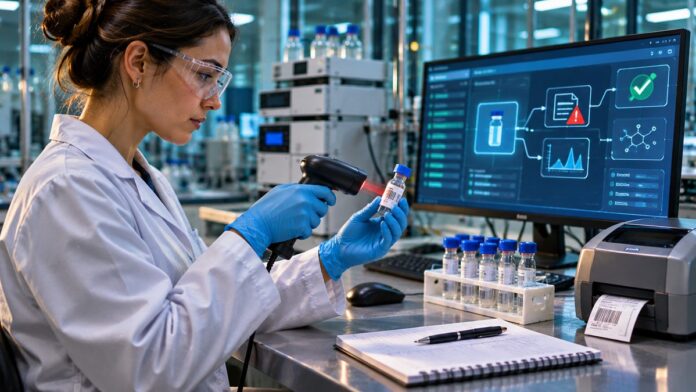
The scanner beeped, the sample identifier appeared on the screen, and the laboratory employee watched the inventory system confirm that the container was stored in the correct location. By ordinary warehouse standards, everything seemed to be working. Yet when a researcher later requested the analytical report associated with that material, the team could not establish which laboratory result belonged to the container.
The situation is hypothetical, but it exposes a common weakness in digital inventory design. Finding a sample is not the same as identifying the scientific evidence that describes it. A barcode can establish which database entry a reader accessed without proving that the corresponding analytical report applies to the physical material.
Modern laboratories use barcodes, QR codes, inventory databases, electronic laboratory notebooks, and laboratory information management systems to reduce transcription errors and manage growing numbers of samples. These technologies can improve organization considerably, but their effectiveness depends on the relationships established between records.
For research materials, the central question is not simply where an item is stored. It is whether the physical container, supplier lot, internal sample record, analytical test, and resulting report can be connected through a traceable sequence of evidence.
A Barcode Can Find a Container Without Verifying Its Contents
A barcode is a machine-readable identifier. When a scanning device reads the code, the software retrieves or records information associated with that identifier. What the system displays depends on the accuracy of the underlying database and the design of its relationships.
Consider a laboratory that assigns an internal inventory number to each research-material container. Scanning the label might reveal the product name, receiving date, storage location, and assigned employee. That information is useful for inventory control.
However, the system might not contain the original supplier lot number, the laboratory sample identifier used during testing, or the report number associated with the tested material.
The scanner has performed its intended identification task, but the inventory record remains incomplete for scientific traceability.
In other words, the system can answer where the container is while failing to answer what analytical evidence applies to it.
This distinction becomes especially important when several containers have the same product description but originate from different production or packaging lots. A shared product name cannot establish that the materials have identical histories or test results.
Why Product Names Are Poor Substitutes for Lot Identifiers
Scientific inventories often contain groups of materials with similar names, specifications, and packaging. Those similarities make standardized identifiers essential.
A product name describes a category or identity claimed for a material. A lot identifier connects material to a defined production, handling, or packaging group. An internal container identifier distinguishes a particular physical unit in the receiving laboratory’s inventory.
These identifiers serve different purposes and should not automatically replace one another.
Suppose a laboratory purchases two containers of the same research material from a supplier at different times. Both containers may share the same product description, but their lots may have different analytical reports or handling histories.
Linking every report under the general product name creates ambiguity because the software cannot determine which document applies to which received lot.
Researchers evaluating supplier documentation can consult this explanation of lot identification, which describes how material identifiers connect physical research products with their associated records.
The underlying supplier page is educational material, not independent verification of the analytical quality of any specific lot.
An effective digital system preserves the relationships between product descriptions, supplier lot identifiers, physical containers, and testing records rather than collapsing them into a single searchable name.
The Difference Between Tracking and Provenance
Tracking and provenance are closely related, but they are not interchangeable concepts.
Tracking commonly describes where an item is located and how it moves between locations or organizational processes. Provenance concerns the history and origin of an item or dataset, including the processes and transformations that produced the information being examined.
In April 2023, researchers associated with the National Institute of Standards and Technology and international scientific collaborators published work titled Toward a Common Standard for Data and Specimen Provenance in Life Sciences.
The publication emphasizes the importance of understanding the relationship between specimens, methods, information, and derived research data. Its broader concern is whether scientific material and information can be interpreted accurately and reused responsibly.
For a small laboratory, this idea becomes practical when an analytical result is connected to a specific sample and the relevant history can be reconstructed.
A barcode record might show that a container moved from receiving to refrigerated storage. A provenance record might additionally establish which portion of that material was sampled, when the analysis occurred, which method was used, and how the reported result was generated.
Both types of information are valuable. Neither should be mistaken for the other.
One Physical Sample May Have Several Digital Identifiers
Laboratory record systems frequently use multiple identifiers because each organization or instrument has its own information structure.
A supplier may assign one lot code. The purchasing laboratory may create a separate receiving number. An external testing laboratory may assign a third sample identifier, while an analytical instrument creates its own sequence of data files.
These differences are not necessarily errors. The problem arises when the relationships are undocumented or cannot be retrieved.
For example, a receiving record might identify supplier lot A17 and container C104. A testing laboratory might report analytical results for sample T891. If the organization has a documented record showing that T891 was taken from C104 and that C104 belongs to lot A17, the different identifiers can be reconciled.
Without that connection, attaching the report to the container merely because the product names appear similar would be an unsupported assumption.
Digital inventory software should therefore allow organizations to preserve these associations rather than forcing every system to use the same identifier.
Clear cross-references are particularly important when materials are divided, repackaged, transferred, or sampled for testing.
How LIMS and Electronic Notebooks Serve Different Functions
A laboratory information management system, commonly called a LIMS, may help laboratories register samples, assign identifiers, organize workflows, and connect tests with reported outcomes.
An electronic laboratory notebook may focus more directly on recording experimental observations, reasoning, methods, and associated research files.
Inventory management platforms often concentrate on quantities, locations, ordering, and material movement.
Organizations may use separate software products for these functions, or they may rely on a combined platform. A sophisticated laboratory might connect several applications through interfaces that share identifiers and selected records.
The risk appears at the boundaries between systems.
If the inventory software stores a container number but the LIMS stores only an analytical sample number, employees need a reliable connection between those records. Otherwise, the organization may be unable to establish which test result belongs to a particular container.
Automatic synchronization can reduce repetitive data entry, but synchronization also needs controls. An incorrect relationship transferred automatically into multiple systems does not become accurate simply because the software exchange succeeded.
Data integration should therefore be designed around clearly defined records and identifiers rather than convenience alone.
Independent Testing Still Requires an Identifiable Sample
External laboratory testing can create a useful separation between the company supplying a research material and the laboratory performing a particular measurement.
However, the analytical report remains evidence about the submitted sample and the characteristics evaluated through the stated methods.
It does not automatically describe another container or every lot sold under the same product name.
In USA Peptide Depot’s independent-testing overview, the supplier explains that reviewing third-party analytical information requires attention to sample identification, testing dates, laboratory identity, methods, and reported findings.
Those are useful review questions, but they do not independently establish that the supplier’s advertised testing occurred as described. Each report must be assessed on its own terms.
A receiving laboratory should determine whether the report can be connected to the material under consideration. If it cannot, the appropriate response is to investigate the missing relationship rather than treating the document as proof by association.
The key question is what was actually tested, and whether the evidence applies to the physical material now present in the laboratory.
Why a Perfectly Scanned PDF May Still Be an Incomplete Scientific Record
Many laboratory workflows rely on PDFs because they are convenient to share, store, and review. A PDF can present an analytical report clearly, but it may contain only a summary of the data generated during testing.
For instance, an analytical instrument can create raw data files, method information, processing settings, and records of changes made during data analysis. A final report may include only selected results or images.
The U.S. Food and Drug Administration’s guidance on data integrity under drug current good manufacturing practice discusses the importance of maintaining reliable original electronic data and the metadata necessary to understand them.
In a related FDA explanation concerning computerized analytical records, the agency notes that a printed chromatogram does not necessarily contain the full electronic record supporting the result.
These FDA requirements apply within their specific regulatory scope and should not be represented as universal legal obligations for every research supplier.
Nevertheless, they provide a valuable distinction for any organization evaluating scientific records: a report intended for communication may not contain the complete underlying evidence.
Scanning a PDF, assigning it a filename, and placing it beside an inventory entry can improve access. It does not resolve missing sample relationships or establish that the underlying measurement was valid.
What Data Integrity Means Beyond Preventing Deletion
Data integrity is often discussed as a cybersecurity concern, but its scientific meaning is broader.
The FDA’s December 2018 guidance describes data integrity in terms of completeness, consistency, and accuracy. The guidance also discusses the well-known ALCOA attributes: attributable, legible, contemporaneously recorded, original or a true copy, and accurate.
These principles explain why reliable scientific records require more than protection against unauthorized deletion.
A sample record should show who entered or modified important information, when relevant activities occurred, and how any corrections were made. The recorded information should remain understandable and connected to the source activity.
A system can preserve every file while still failing to maintain an accurate relationship between a tested sample and its originating material.
Likewise, a user may accidentally select the wrong lot from a dropdown menu. The database may save that selection faithfully, but the saved relationship is still incorrect.
Digital controls should therefore address both record security and the accuracy of the information being captured.
Employees also need training, appropriate authority, and a way to report uncertain or conflicting information without silently changing earlier entries.
Audit Trails Explain How Records Changed
An audit trail records relevant changes to electronic information so that authorized reviewers can understand how a record developed over time.
For example, a technician might initially associate an analytical report with the wrong inventory identifier. After discovering the mistake, the technician corrects the relationship and documents the reason for the change.
A useful audit trail helps reviewers distinguish the original entry from the later correction.
FDA’s guidance on electronic records and electronic signatures discusses audit trails and related record controls in regulated contexts. The agency also explains that the applicability of particular requirements depends on the governing regulations and the records involved.
For organizations outside that regulatory scope, the operational principle remains useful: important corrections should be understandable rather than invisible.
Audit trails should not be mistaken for proof that every entry is correct. They document the history of system activity, which helps people investigate possible mistakes and determine whether the records remain trustworthy.
In a well-designed laboratory workflow, a corrected relationship can be reviewed without erasing the evidence that a different relationship was entered earlier.
What RFID Adds and What It Cannot Establish
Radio-frequency identification, or RFID, can help identify and track objects without requiring the same direct visual alignment used by many optical barcode scanners.
Depending on the system, RFID may support faster inventory checks, location workflows, or automated detection of tagged items.
However, RFID does not independently verify chemical identity, purity, sample composition, or the validity of an analytical report.
An RFID tag is another route to a digital record. If the underlying record associates the item with an incorrect lot or unsupported test result, the technology can retrieve the incorrect information efficiently.
That limitation is important when organizations consider investing in advanced sample-management technology.
The business case should account for what the technology actually improves. Faster identification and fewer manual scans may offer operational benefits, but scientific traceability also depends on dependable records and correctly defined relationships.
Equipment upgrades should be assessed alongside data governance, employee training, and procedures for resolving conflicting information.
Good Documentation Standards Require Specific Questions
Suppliers often describe their research-material processes using broad terms such as traceable, independently tested, or documented.
Those descriptions become useful only when they can be connected to specific evidence.
For example, the supplier’s documentation standards published by USA Peptide Depot discuss lot identification, analytical records, and operational accountability.
This is a statement of the supplier’s intended approach. It is not a substitute for checking an individual lot, laboratory report, and applicable analysis.
A responsible laboratory reviewer may ask which lot the report covers, who performed the analysis, when it was completed, what the analytical method measured, and whether the sample relationship is sufficiently documented.
The reviewer should also distinguish between the existence of analytical evidence and conclusions that go beyond the scope of the testing.
A chromatographic result, for instance, cannot automatically establish every characteristic of a material. Different questions may require different analytical methods.
Precise documentation standards reduce ambiguity because they turn general claims into records that can be evaluated.
Building a Reliable Digital Chain From Receiving to Results
A practical digital traceability workflow begins when a research material arrives and continues through any subsequent sampling, analysis, storage, or disposal activities relevant to the organization.
The receiving employee records the physical identifiers on the material and any applicable shipping documentation. The inventory system assigns an internal identifier while preserving the supplier’s original lot reference.
If part of the material is submitted to a testing laboratory, the organization records how the submitted sample relates to the source container.
When the analytical report returns, the reviewer checks whether the report’s sample designation can be reconciled with the laboratory’s documented sample submission.
The report may then be associated with the appropriate material record, along with information about the analysis performed and any limitations relevant to its interpretation.
If the identifiers conflict, the workflow should flag the exception and prevent unsupported assumptions from becoming routine inventory data.
These steps do not require every laboratory to use the same commercial software. They require a clear data model, defined responsibilities, and a recordkeeping process appropriate to the work being performed.
Systems should make it easy to find missing links instead of encouraging users to fill them with guesses.
Five Tests for a Laboratory Inventory System
Before introducing barcode scanners or replacing existing software, a research organization can evaluate whether its proposed system answers five basic questions.
- Identity: Can a user distinguish a product description, supplier lot, internal container, and analytical sample without mixing them together?
- Relationships: Can the system show why a particular analytical report is connected to a particular physical material?
- History: Can an authorized reviewer reconstruct relevant receiving, sampling, transfer, and correction events?
- Exceptions: Does the system provide a controlled method for documenting conflicting identifiers or missing evidence?
- Retrieval: Can employees locate the appropriate record without relying on one person’s memory or an undocumented spreadsheet convention?
These questions address practical capability rather than software branding. A modest system with well-maintained relationships may be more useful than an expensive platform populated with inconsistent or incomplete records.
Organizations should also evaluate backup arrangements, access controls, training, and whether records can be exported in an understandable format when technology changes.
Why Better Scanning Is Not the Same as Better Science
Automated identification can make laboratories more efficient. It can reduce repetitive entry, improve physical inventory visibility, and help teams manage materials across multiple storage locations.
But it cannot establish scientific provenance on its own.
A scanner does not know whether a certificate belongs to the sample in front of it unless the relevant relationship has been established and maintained. An electronic notebook cannot make an unsupported analytical conclusion reliable by storing it indefinitely. An RFID system cannot correct a mislabeled lot simply by detecting it more quickly.
The more meaningful objective is a connected record that moves from physical material to sample identity, analytical activity, and interpretable results.
NIST’s work on specimen and data provenance illustrates why these connections matter to the reuse and interpretation of scientific information. FDA’s data-integrity guidance demonstrates why electronic record quality involves accuracy, completeness, metadata, and the ability to understand how information changed.
For small research laboratories and suppliers, the practical lesson is direct: technology should make evidence relationships clearer, not merely make inventory searches faster.
A beep from a scanner can confirm that a code was recognized. A trustworthy scientific record should be able to explain what that code means, where the material came from, which test results actually belong to it, and which questions remain unanswered.

